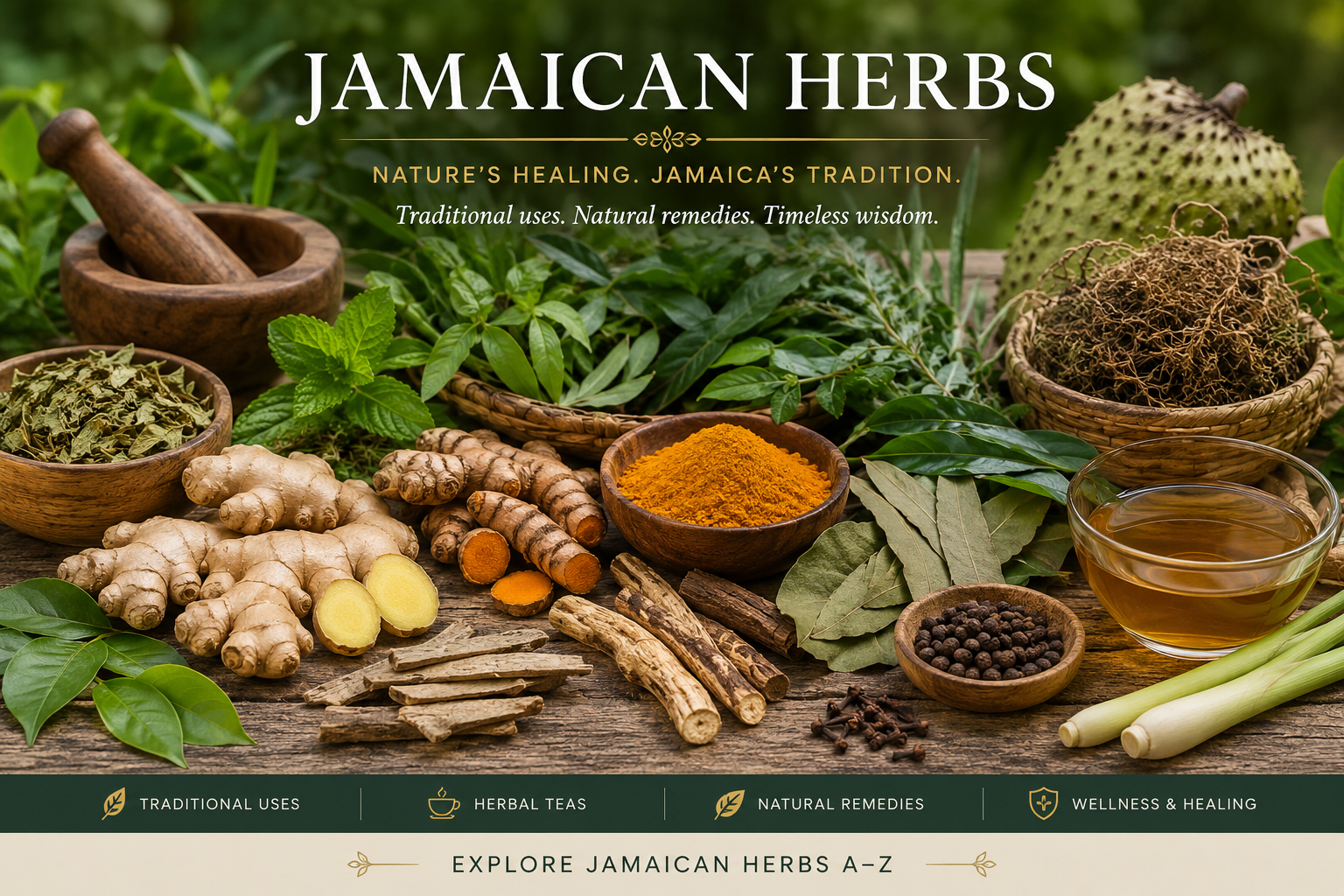
Jamaican Herbs A–Z: Traditional Uses, Botanical Names, Tea Preparation & Scientific Research
Jamaican herbs have been used for generations in bush teas, roots drinks and traditional home preparations. This A–Z guide brings together Jamaican common names, botanical names, traditional uses, preparation methods, research context and practical safety notes in one resource.
This guide was created to help preserve that knowledge while clearly separating traditional Jamaican use from modern scientific evidence.
Important: Traditional use does not automatically mean a health effect has been scientifically proven. This guide is educational and is not a substitute for medical advice, diagnosis or treatment.
Quick A–Z Navigation
Research sources: view references
How to Read This Guide
Traditional Use: How an herb has historically been used in Jamaican, Caribbean or other herbal traditions.
Scientific Research: Laboratory, animal or human studies investigating the plant or its constituents.
Human Research: Evidence from studies involving people. Quality and strength can vary.
Clinical Evidence: Used where meaningful controlled human research exists for a particular application.
Shop Jamaican Herbs
Browse our selection of Jamaican wildcrafted and imported herbs.
Shop All Herbs
A
About the Herb
Alfalfa is a nutrient-rich plant containing chlorophyll, minerals, flavonoids and saponins.
Traditional Uses
Traditionally associated with general nourishment, vitality, digestive wellness and women’s herbal preparations.
Potential Benefits
Research has investigated its antioxidant activity, nutrition and possible effects on lipid metabolism.
What Scientific Research Says
Interesting nutritional and pharmacological research exists, but strong clinical evidence for many medicinal claims remains limited.
Traditional Preparation / Tea
Place approximately 1–2 teaspoons dried Alfalfa leaf in a cup. Add about 8 oz freshly boiled water, cover and steep for approximately 10–15 minutes. Strain before drinking.
Safety & Precautions
Alfalfa contains vitamin K and may be relevant to people taking warfarin or other vitamin-K-sensitive anticoagulants.
Evidence Level: Traditional use | Preliminary research
Back to top ↑
About the Herb
All Man Strength belongs to Jamaica’s distinctive roots tradition. Its name reflects its traditional reputation for strength, stamina and masculine vitality.
Traditional Jamaican Uses & Folklore
Traditionally associated with male vitality, sexual stamina, energy, weakness and “building up” the body.
What Scientific Research Says
Its Jamaican roots use is better documented than any specific clinical medicinal effect. There is insufficient controlled human evidence showing that it increases testosterone or treats erectile dysfunction.
Traditional Preparation
Traditionally prepared as a roots decoction rather than a quick-steep tea. The woody material is cleaned, cut into smaller pieces and slowly simmered with other roots and barks.
Safety & Precautions
Botanical identity should be positively confirmed before species-specific medicinal claims are made.
Evidence Level: Jamaican roots tradition | Insufficient clinical evidence
Back to top ↑
Traditional Jamaican Uses
Traditionally associated with minor burns, irritated skin, hair and scalp preparations and general skin care.
What Scientific Research Says
Human research supports certain topical uses of Aloe, although results depend on the condition and preparation.
Traditional Preparation
The leaf is cut open and the clear inner gel separated from the yellow latex. Aloe is not treated as an ordinary everyday bush tea in this guide.
Safety & Precautions
The yellow latex beneath the rind contains potent laxative compounds and has substantially different safety considerations from the clear gel.
Evidence Level: Traditional topical use | Human topical research
Back to top ↑
Traditional Uses
Traditionally associated with general wellness, urinary complaints and various folk preparations.
Potential Benefits
Annatto contains carotenoid pigments including bixin and norbixin.
What Scientific Research Says
Laboratory research has investigated antioxidant, antimicrobial and anti-inflammatory properties. Human evidence for many medicinal applications remains limited.
Traditional Tea Preparation
Dried leaves may be covered with freshly boiled water and allowed to steep before straining.
Evidence Level: Traditional use | Preliminary research
Back to top ↑
B
About Bissy
Bissy is one of Jamaica’s classic household bush remedies and naturally contains caffeine.
Traditional Jamaican Uses
Traditionally used for upset stomach, indigestion, diarrhea-related complaints, alertness and energy. One well-known Jamaican tradition involves using Bissy after consuming questionable food.
What Scientific Research Says
The stimulant effects of caffeine are well established. There is insufficient evidence that Bissy neutralizes poisons.
Traditional Bissy Tea
A small portion of dried Bissy nut is traditionally grated or shaved, covered with hot water and allowed to steep before straining.
Safety & Precautions
Too much caffeine may cause insomnia, nervousness, palpitations or increased heart rate.
Evidence Level: Strong Jamaican tradition | Established caffeine effects
Back to top ↑
Traditional Jamaican Uses
Traditionally prepared as tea for feverish complaints and general bush medicine.
Traditional Tea
The leaves are traditionally steeped or boiled in water to make a bitter bush tea.
What Scientific Research Says
Human clinical evidence remains limited.
Evidence Level: Documented Jamaican use | Limited research
Back to top ↑
Traditional Uses
Traditionally used as a very bitter digestive tonic and in folk preparations associated with appetite and intestinal wellness.
Preparation
Bark or wood is traditionally prepared by decoction; because of its intense bitterness, small amounts are used.
What Scientific Research Says
Quassinoids and related bitter compounds have been studied mainly in laboratory and preclinical research. Human evidence for broad medicinal claims is limited.
Safety & Precautions
Avoid high or prolonged doses. Pregnancy and significant medical conditions warrant professional advice.
Evidence Level: Traditional use | Laboratory and preclinical research
Back to top ↑
Traditional Jamaican Uses
Traditionally used as an aromatic mint in bush teas and household preparations, particularly for digestion, colds and general wellness.
Preparation
Cover approximately 1 teaspoon dried herb with 8 oz hot water, steep 5–10 minutes and strain.
What Scientific Research Says
Research on Mentha spicata supports aromatic and digestive properties, but studies on ordinary spearmint should not be treated as proof of every traditional Jamaican use.
Safety & Precautions
Generally used as a food herb and tea. Concentrated preparations require greater caution; pregnancy, medication use and persistent symptoms warrant professional advice.
Evidence Level: Traditional use | Species-level research
Back to top ↑
Traditional Uses
Traditionally associated with intestinal-worm preparations, cleansing and antifungal folk preparations.
What Scientific Research Says
Black Walnut contains tannins and juglone and demonstrates biological activity in laboratory studies. Reliable human evidence proving that Black Walnut Hull eliminates intestinal parasites is insufficient.
Traditional Preparation
Traditionally used in decoctions, tinctures and compound herbal formulas rather than as an everyday beverage tea.
Safety & Precautions
Concentrated or prolonged use warrants caution. People with relevant nut allergies should also exercise caution.
Evidence Level: Traditional parasite reputation | Laboratory research
Back to top ↑
Traditional Jamaican Uses
Traditionally associated with strength, vitality, male wellness and Jamaican roots.
Traditional Preparation
Black Wist is cleaned, cut and slowly simmered with other roots, vines and barks.
What Scientific Research Says
Its ethnobotanical role is much better documented than its clinical medicinal effects.
Traditional Uses
Traditionally used as a mineral-rich seaweed and in thyroid/weight-related folk preparations.
Preparation
Usually prepared as a brief decoction or incorporated into blends; preparation should account for its naturally occurring iodine.
What Scientific Research Says
Bladderwrack contains iodine, alginates and polyphenols. Evidence for weight loss or thyroid treatment is insufficient.
Safety & Precautions
Iodine content can vary widely. People with thyroid disease, those taking thyroid medicines, or those who are pregnant should seek medical advice before substantial use.
Evidence Level: Traditional use | Nutritional and preliminary research
Back to top ↑
Traditional Uses
Traditionally associated with appetite, digestion, bitter tonics and lactation folk preparations.
Tea Preparation
Cover approximately 1 teaspoon dried herb with 8 oz hot water. Steep for around 10 minutes and strain.
What Scientific Research Says
Its bitter constituents support its traditional digestive reputation, but evidence that it reliably increases breast-milk production is limited.
Traditional Jamaican Uses
Used in roots preparations associated with strength, vitality and general tonic use.
Traditional Preparation
Prepared by prolonged decoction with other roots and barks rather than as an ordinary quick-steep tea.
Traditional Jamaican Uses
Associated with colds, digestive complaints, feverish feelings, relaxation and general bush tea.
Potential Benefits
Research has investigated antioxidant, antimicrobial and anti-inflammatory properties.
Tea Preparation
Cover approximately 1–2 teaspoons dried herb with 8 oz freshly boiled water. Steep covered for 10–15 minutes and strain.
What Scientific Research Says
Most evidence remains preclinical.
Evidence Level: Jamaican traditional use | Preclinical research
Back to top ↑
Traditional Caribbean Uses
Traditionally associated with blood-pressure, blood-sugar and cardiovascular wellness.
Traditional Preparation
The dried mature leaf is cut into pieces and gently simmered in water before straining.
What Scientific Research Says
Antioxidant, metabolic and cardiovascular effects have been investigated, but much of the evidence remains preclinical.
Evidence Level: Caribbean traditional use | Preliminary research
Back to top ↑
Traditional Uses
Associated with nourishment, strength and traditional tonic preparations.
Preparation
Leaves may be steeped. Bark used in roots is decocted. Edible seeds are prepared as food rather than ordinary tea.
Traditional Uses
Associated with skin wellness, digestion, cleansing and traditional “blood-cleansing” formulas. “Blood cleansing” is traditional herbal terminology and should not be interpreted literally as removing toxins from blood.
Traditional Root Tea
Simmer approximately 1–2 teaspoons dried cut root in about 10 oz water for 10–15 minutes. Strain.
What Scientific Research Says
Preclinical research is interesting, but strong human evidence for broad detoxification claims is limited.
Evidence Level: Extensive traditional use | Preclinical research
Back to top ↑
C
Traditional Uses
Associated especially with skin soothing, minor wounds, irritated skin and herbal washes.
Tea
Steep approximately 1–2 teaspoons dried flowers in 8 oz hot water for 10–15 minutes.
What Scientific Research Says
Human research exists particularly for topical preparations.
Evidence Level: Traditional topical use | Some human topical research
Back to top ↑
Traditional Uses
Traditionally used in Amazonian herbal medicine for inflammatory complaints and general wellness.
Preparation
Bark is generally prepared by decoction rather than a quick infusion.
What Scientific Research Says
Some human and preclinical studies exist, but evidence is not sufficient for broad disease-treatment claims.
Safety & Precautions
May interact with immune-suppressing, blood-pressure or anticoagulant medicines. Avoid in pregnancy unless medically advised.
Evidence Level: Extensive traditional use | Preliminary human research
Back to top ↑
About Cerasee
Cerasee is one of Jamaica’s best-known bitter bush teas.
Traditional Jamaican Uses
Traditionally associated with cleansing, digestive complaints, skin complaints, “cooling” the body and blood-sugar-related folk preparations.
Potential Benefits
Momordica charantia contains compounds that have been investigated for their effects on glucose metabolism.
What Scientific Research Says
Human studies exist, but results and evidence quality vary. Cerasee should not replace diabetes medication.
Traditional Cerasee Tea
Cover approximately 1–2 teaspoons dried leaves or vine with 8 oz freshly boiled water and steep for 10–15 minutes. It can also be gently boiled. Cerasee is naturally very bitter; excessively concentrated preparations are unnecessary.
Safety & Precautions
People taking glucose-lowering medication should exercise caution. Concentrated medicinal use during pregnancy should be avoided unless professionally advised.
Evidence Level: Strong Jamaican tradition | Human research exists
Back to top ↑
About Chainy Root
Chainy Root is one of the defining ingredients of Jamaican roots culture.
Traditional Jamaican Uses
Associated with strength, stamina, sexual vitality, weakness and “building up” the body.
Traditional Preparation
Clean and break the dried root into smaller pieces. Cover with water, bring to a boil and reduce to a slow simmer. Chainy is frequently combined with Sarsaparilla, Strong Back, Medina and other roots.
What Scientific Research Says
Its importance to Jamaican ethnomedicine is strongly documented, but clinical evidence for sexual-performance or fertility claims remains limited.
Evidence Level: Exceptional Jamaican roots documentation
Back to top ↑
Traditional Uses
Cooling preparations, skin wellness, cleansing and weight-management folk blends.
Tea
Steep approximately 1–2 teaspoons dried herb in 8 oz hot water for 10–15 minutes.
What Scientific Research Says
There is insufficient clinical evidence that Chickweed produces meaningful weight loss.
Traditional Uses
Digestion, warming teas, gas, colds and blood-sugar-related preparations.
Cinnamon Tea
Simmer a small Cinnamon stick in approximately 8–12 oz water for about 10 minutes.
What Scientific Research Says
Human metabolic research exists, although results vary according to species and preparation.
Safety
Cassia Cinnamon generally contains more coumarin than Ceylon Cinnamon.
Evidence Level: Extensive traditional use | Human research
Back to top ↑
Traditional Uses
Toothache, oral wellness, digestion, warming teas and parasite formulas.
Tea
Lightly crush approximately 2–4 whole cloves, cover with hot water and steep for about 10 minutes.
What Scientific Research Says
Eugenol is well studied. Laboratory antiparasitic activity does not establish Clove tea as a human parasite treatment.
Evidence Level: Extensive traditional use | Considerable research
Back to top ↑
Traditional Jamaican Uses
Male vitality, stamina, strength and roots preparations.
Preparation
Traditionally slowly decocted with roots and barks.
What Scientific Research Says
There is insufficient evidence that Cocky Wist treats erectile dysfunction or increases testosterone.
Traditional Uses
Used in Caribbean/Jamaican roots traditions as a supporting ingredient in strength and tonic decoctions.
Preparation
Cleaned root is cut and slowly simmered with other roots and barks.
What Scientific Research Says
The coconut plant is well studied nutritionally, but clinical evidence specifically for coconut root preparations is limited.
Safety & Precautions
Use traditional food/herbal quantities; concentrated medicinal use lacks strong human safety data.
Evidence Level: Jamaican/Caribbean traditional use | Limited specific research
Back to top ↑
Traditional Uses
Used traditionally in tropical American herbal practice for digestive, topical and general wellness preparations.
Preparation
Leaves may be infused; tougher material is more often gently decocted.
What Scientific Research Says
Laboratory research has examined antimicrobial, antioxidant and insecticidal constituents, but human clinical evidence remains limited.
Safety & Precautions
Essential-oil chemistry can be concentrated and should not be assumed equivalent to ordinary tea.
Evidence Level: Traditional use | Laboratory and preclinical research
Back to top ↑
Traditional Uses
Urinary wellness, bladder preparations and fluid balance.
Tea
Cover approximately 1 tablespoon dried Corn Silk with 8 oz hot water. Steep 10–15 minutes and strain.
What Scientific Research Says
Diuretic, antioxidant and metabolic activity has been investigated, but much evidence remains preliminary.
Evidence Level: Traditional use | Preliminary research
Back to top ↑
Traditional Uses
Traditionally associated with general bush medicine and various household herbal preparations.
Preparation
Leaves may be steeped or gently boiled in water and strained.
Research
Species identification should be finalized before attaching detailed pharmacological claims.
Evidence Level: Traditional use | Botanical verification recommended
Back to top ↑
D
Traditional Uses
Famous traditionally for libido, sexual vitality, nervous tension, relaxation and general tonic use.
Tea
Steep approximately 1–2 teaspoons dried leaf in 8 oz hot water for 10–15 minutes.
Research
Its aphrodisiac reputation is substantially stronger in traditional medicine than in controlled human trials.
Evidence Level: Strong traditional reputation | Preliminary research
Back to top ↑
Traditional Uses
Dandelion Leaf is associated particularly with urinary and fluid-balance preparations. Dandelion Root is associated more strongly with digestion and bitter or liver-support formulas.
Preparation
Leaf: Steep approximately 1–2 teaspoons in hot water for 10–15 minutes.
Root: Simmer approximately 1–2 teaspoons dried root for 10–15 minutes.
What Scientific Research Says
Preclinical evidence is more extensive than human clinical evidence.
Evidence Level: Long traditional use | Considerable preliminary research
Back to top ↑
About Dog Blood
Dog Blood is one of Jamaica’s distinctive women’s folk herbs.
Traditional Jamaican Uses & Folklore
Traditionally associated with women’s reproductive wellness, menstrual complaints, fertility preparations, “cleaning the womb,” difficulty conceiving and what is commonly described in Jamaican folk medicine as “blocked tubes.”
What Scientific Research Says
There is no good controlled human evidence showing that Dog Blood opens blocked fallopian tubes or treats infertility.
Traditional Preparation
The cleaned plant material is traditionally steeped or gently boiled in water and strained. Traditional strength varies considerably, so a standardized high-dose regimen should not be invented.
Safety & Precautions
Fertility concerns and suspected blocked fallopian tubes require appropriate medical evaluation. Concentrated reproductive herbal preparations warrant particular caution during pregnancy.
Evidence Level: Strong Jamaican fertility folklore | Preliminary research | Insufficient fertility evidence
Back to top ↑
Traditional Uses
Traditionally associated with calming, pain-related and sleep-related folk preparations in Caribbean herbal practice.
Preparation
Bark has traditionally been decocted, but dosing should be conservative and professionally guided.
What Scientific Research Says
Pharmacological research is largely preclinical; strong modern human clinical evidence is limited.
Safety & Precautions
Can be sedating and should not be combined casually with sedative medicines or alcohol. Avoid during pregnancy unless medically advised.
Evidence Level: Caribbean traditional use | Preliminary research
Back to top ↑
Traditional Uses
Has a history of traditional use in parts of the Caribbean and tropical Americas.
Preparation
Because Aristolochia species are associated with serious toxicity, this guide does not provide an internal-use tea, detox, or dosage recipe for either the flower or the leaves and stems/vine.
What Scientific Research Says
Kew identifies <em>Aristolochia grandiflora</em> as poisonous to humans and livestock. Aristolochia species are associated with aristolochic-acid toxicity, including severe kidney injury and carcinogenic risk.
Safety & Precautions
Duck Flower and Duck Flower Wiss come from the same Aristolochia plant. The leaves and stems/vine should not be presented as a safer internal-use alternative to the flower. Aristolochia species require a strong safety warning.
Evidence Level: Traditional use | Major safety concern
Back to top ↑
E
Traditional Uses
Traditionally associated with coughs, mucus, respiratory preparations and digestion.
Preparation
Because it is a root, Elecampane is commonly decocted. Dried root is placed in water and gently simmered before straining.
What Scientific Research Says
Laboratory antimicrobial and other pharmacological activities have been investigated, but strong clinical evidence for many respiratory claims is limited.
Safety
People with allergies to plants in the Asteraceae family should exercise caution.
Evidence Level: Long traditional use | Preliminary research
Back to top ↑
F
Traditional Jamaican Uses
Colds, feverish feelings, digestion, gas, relaxation and everyday bush tea.
Tea
Cover approximately 1–2 teaspoons dried Fever Grass—or a small amount of fresh cut leaf—with hot water. Steep covered for 10–15 minutes. It may also be gently simmered. Ginger is a traditional complementary ingredient.
What Scientific Research Says
Antioxidant, antimicrobial and anti-inflammatory properties have been investigated.
Evidence Level: Strong Jamaican household tradition | Considerable research
Back to top ↑
Traditional Jamaican Uses
Strength, stamina, male vitality, sexual wellness and roots.
Preparation
Traditionally slowly decocted with Chainy Root, Sarsaparilla, Strong Back and other roots materials.
What Scientific Research Says
Species-specific claims should not be made until botanical identity is confirmed.
Traditional Jamaican Uses
Used in Jamaican roots culture in preparations associated with strength, stamina and male vitality.
Preparation
Traditionally slowly decocted with other roots and barks such as Chaney, Strong Back and Sarsaparilla.
What Scientific Research Says
The species has ethnobotanical and pharmacological research, but traditional strength or sexual-health claims have not been established in controlled human trials.
Safety & Precautions
Do not claim that it increases testosterone, sperm count or treats erectile dysfunction without clinical evidence.
Evidence Level: Jamaican roots tradition | Limited species research
Back to top ↑
G
Traditional Uses
Digestion, colds, circulation, cardiovascular wellness and general household remedies.
Traditional Preparation
Garlic is usually consumed as food or incorporated into compound herbal preparations rather than treated as an ordinary leafy tea. Crushed Garlic may be steeped in hot water with Ginger or citrus in household preparations.
What Scientific Research Says
Garlic has meaningful human research, particularly concerning certain cardiovascular risk factors.
Evidence Level: Extensive traditional use | Considerable human research
Back to top ↑
Traditional Jamaican Uses
Nausea, upset stomach, gas, colds, warming the body, menstrual discomfort and roots.
Ginger Tea
Slice approximately ½–1 inch fresh Ginger and simmer in 8–12 oz water for approximately 10 minutes. Dried Ginger requires less material.
What Scientific Research Says
Ginger is one of the better-researched herbs in this guide, with meaningful human evidence for certain forms of nausea.
Evidence Level: Strong tradition | Comparatively strong human evidence for selected uses
Back to top ↑
Traditional Jamaican Uses
General cleansing, pain-related preparations, respiratory complaints and traditional wellness formulas.
What Scientific Research Says
Antioxidant, anti-inflammatory, antimicrobial and cancer-cell research exists. Laboratory cancer-cell activity does not mean Guinea Hen Weed tea cures cancer.
Tea
Dried herb may be covered with hot water and steeped for approximately 10–15 minutes. Some traditional preparations use gentle decoction.
Safety
Plant part should be identified because root, stem and leaf preparations may differ. Concentrated use warrants caution during pregnancy.
Evidence Level: Strong Jamaican tradition | Significant preclinical research
Back to top ↑
I
Traditional Jamaican Uses
Nourishment, strength, vitality, Jamaican punches and male-tonic drinks.
Traditional Preparation
Irish Moss is generally rinsed, soaked and then heated or blended to produce a gel or thick beverage rather than being prepared as ordinary bush tea.
What Scientific Research Says
Seaweed can provide minerals, polysaccharides and iodine, but many modern health claims exceed available human evidence.
Safety
Iodine content varies. Excessive consumption may be inappropriate for some people with thyroid conditions.
Evidence Level: Strong Jamaican food and tonic tradition | Nutritional research
Back to top ↑
J
Traditional Jamaican Uses
A Jamaican bush herb traditionally used in household herbal preparations.
Preparation
Traditional preparation varies with intended use; avoid presenting a standardized medicinal dose where clinical dosing has not been established.
What Scientific Research Says
The plant has been studied for antimicrobial, anti-inflammatory and wound-related activity, much of it preclinical. This does not establish it as a treatment for disease.
Safety & Precautions
Internal medicinal use requires caution because traditional use does not establish safety for concentrated or prolonged consumption.
Evidence Level: Jamaican traditional use | Preclinical research
Back to top ↑
Traditional Uses
Digestion, feverish complaints, cleansing, bitter tonics and parasite-related folk preparations.
Tea
Use a small amount because the herb is exceptionally bitter. Cover with hot water and steep approximately 10 minutes before straining.
Research
Antimicrobial, anti-inflammatory and antiparasitic laboratory research exists, but this does not establish the tea as a clinically proven parasite treatment.
Evidence Level: Strong Caribbean tradition | Preliminary research
Back to top ↑
Traditional Uses
Traditionally used in Caribbean herbal practice in digestive, respiratory and general bush preparations.
Preparation
Leaves may be steeped or gently boiled and strained.
What Scientific Research Says
Laboratory research has examined antioxidant and antimicrobial activity, but strong human clinical evidence is limited.
Safety & Precautions
Use as a traditional tea rather than as a substitute for treatment of respiratory or digestive disease.
Evidence Level: Traditional use | Preliminary research
Back to top ↑
K
Traditional Uses
Traditionally associated with skin, immune and general wellness preparations in Central American and Caribbean herbal traditions.
Preparation
The rhizome is particularly associated with traditional calaguala preparations and is generally decocted. Commercial material may contain other plant portions.
What Scientific Research Says
Research on standardized fern extracts cannot automatically be applied to every fern sold under the common name Kalawalla/Calaguala.
Safety & Precautions
Avoid disease-treatment claims or concentrated dosing without authenticated species and plant-part information.
Evidence Level: Traditional use | Genus association; species unconfirmed
Back to top ↑
Traditional Uses
Well known in Caribbean folk medicine, especially for topical preparations associated with fungal skin complaints; it also appears in traditional teas and baths.
Preparation
For internal use, keep preparations conservative. The leaves are also widely used externally in traditional practice.
What Scientific Research Says
Senna alata is an accepted species native to Jamaica. Laboratory and traditional-use evidence supports interest in antimicrobial and antifungal activity, but ordinary tea is not a proven treatment.
Safety & Precautions
Senna-family plants can have laxative effects. Avoid excessive or prolonged internal use.
Evidence Level: Strong traditional use | Laboratory/preclinical research
Back to top ↑
L
Traditional Jamaican Uses
Coughs, colds, chest complaints, urinary complaints, bruises, boils and minor skin applications.
Preparation
Clean leaf may be cut or bruised and steeped or gently boiled. Fresh leaves are also traditionally bruised for external applications.
Research
Anti-inflammatory, antimicrobial, antioxidant and wound-related effects have been investigated primarily preclinically.
Evidence Level: Strong Jamaican traditional use | Preliminary research
Back to top ↑
Traditional Uses
Historically associated with joint and rheumatic complaints, pain and medicinal decoctions.
Preparation
Wood or related material was historically prepared through decoction.
Safety & Conservation
Only correctly identified, lawfully and sustainably sourced material should be commercialized.
Evidence Level: Major Jamaican cultural importance | Historical medicinal use
Back to top ↑
M
Traditional Uses
Has a history of folk use in the Caribbean, but the plant is also known for biologically active alkaloids and toxicity concerns.
Preparation
This guide does not recommend a routine internal tea formula because safety is a significant issue.
What Scientific Research Says
Available evidence is predominantly botanical, toxicological and preclinical rather than strong human clinical evidence.
Safety & Precautions
Treat as a potentially toxic herb. Avoid casual internal use, especially during pregnancy, in children, or alongside prescription medicines.
Evidence Level: Traditional use | Significant safety concern
Back to top ↑
Traditional Uses
Male vitality, stamina, strength and roots drinks.
Preparation
The woody vine or stem is traditionally cut and slowly decocted with other roots.
Traditional Jamaican Uses
Traditionally associated with menstrual discomfort, gas and indigestion, sexual vitality, aphrodisiac preparations and Jamaican roots.
Tea Preparation
Dried Medina aerial herb may be covered with hot water and allowed to steep before straining. For roots preparations, it is combined with tougher roots and barks and subjected to longer decoction.
What Scientific Research Says
Preclinical research exists, but there is insufficient good-quality human evidence proving aphrodisiac effects.
Evidence Level: Strong Jamaican traditional use | Preliminary research
Back to top ↑
Traditional Uses
Strength, vitality and Jamaican roots.
Preparation
Traditionally cleaned, cut and slowly decocted with other roots ingredients.
Traditional Uses
Nutrition, strength, general wellness and blood-sugar and blood-pressure folk preparations.
Tea
Cover approximately 1–2 teaspoons dried Moringa Leaf with hot water. Steep for 5–10 minutes and strain.
What Scientific Research Says
Moringa is genuinely nutrient-rich. Human research exists for metabolic outcomes, but it should not replace diabetes or blood-pressure medication.
Evidence Level: Traditional use | Emerging human research
Back to top ↑
Traditional Uses
Coughs, throat irritation, mucus and respiratory wellness.
Tea
Steep approximately 1–2 teaspoons dried leaf in hot water for 10–15 minutes. Strain very well through a fine filter because Mullein’s tiny hairs can irritate the throat.
Research
Human clinical evidence remains limited.
Evidence Level: Strong traditional respiratory use | Preliminary research
Back to top ↑
N
Traditional Uses
Traditionally used internationally for skin, oral hygiene and various cleansing preparations.
Preparation
Leaf may traditionally be decocted, but Neem should not be promoted as an unrestricted everyday beverage tea.
Research
Neem has substantial laboratory research, but clinical evidence varies considerably by application.
Safety
Concentrated internal use, especially Neem oil, has important safety considerations. Pregnancy warrants particular caution.
Evidence Level: Extensive traditional use | Considerable preclinical research
Back to top ↑
Traditional Jamaican Uses
Strength, vitality, male wellness and roots.
Preparation
The woody stem is cut into pieces and slowly decocted with other roots ingredients.
Research
There is insufficient clinical evidence showing that Nerve Wist increases testosterone or fertility.
Evidence Level: Strong Jamaican roots documentation
Back to top ↑
Traditional Uses
Nettle Leaf is associated with nourishment, urinary wellness and general tonic use. Nettle Root is associated with male urinary and prostate-related preparations.
Tea
Steep approximately 1–2 teaspoons dried leaf in 8 oz hot water for 10–15 minutes. Root is better suited to decoction.
Research
Human research exists for certain standardized Nettle Root preparations used for lower urinary tract symptoms.
Evidence Level: Extensive traditional use | Human research for selected preparations
Back to top ↑
Traditional Uses
General wellness, digestion, pain-related folk preparations and tonic use.
Noni Leaf Tea
Cover dried leaf with hot water and steep for approximately 10–15 minutes. Noni fruit is more commonly made into juice or fermented preparations.
Safety
People with kidney disease or potassium-related restrictions should exercise caution with substantial intake.
Evidence Level: Traditional use | Considerable preliminary research
Back to top ↑
Traditional Uses
Used as a culinary spice and in warming digestive, sleep and tonic folk preparations.
Preparation
A small culinary amount may be grated into tea or food; it should not be prepared as a high-dose medicinal drink.
What Scientific Research Says
Nutmeg contains myristicin and other aromatic compounds. Evidence for therapeutic effects is limited, while high doses are known to cause toxicity.
Safety & Precautions
Do not use large medicinal doses. Excess nutmeg can cause serious neurological and cardiovascular symptoms.
Evidence Level: Extensive culinary/traditional use | Known high-dose toxicity
Back to top ↑
O
Traditional Uses
Digestive teas, bitters, warming preparations and flavoring for roots.
Tea
Steep approximately 1–2 teaspoons dried peel in hot water for around 10 minutes. It can also be simmered with Ginger, Cinnamon or Pimento.
Evidence Level: Culinary and herbal tradition | Phytochemical research
Back to top ↑
P
Traditional Uses
Digestion, cleansing, bitter tonics and parasite-related folk preparations.
Preparation
Cleaned leaf is cut and gently boiled or simmered before straining.
What Scientific Research Says
Human research has investigated Papaya Leaf preparations in relation to platelet counts in dengue, but it should not replace appropriate medical care.
Safety
Concentrated medicinal preparations warrant particular caution during pregnancy.
Evidence Level: Traditional use | Some human research
Back to top ↑
Traditional Uses
General cleansing, fungal-related folk preparations and inflammatory complaints.
Decoction
Dried bark is placed in water, brought to a boil and gently simmered for approximately 10–15 minutes before straining.
Research
Lapachol and related compounds have been investigated in laboratory research. This does not establish Pau D’Arco tea as a cancer treatment.
Safety
Large or concentrated amounts warrant caution, including possible bleeding-related concerns.
Evidence Level: Traditional use | Laboratory research
Back to top ↑
Traditional Uses
Gas, bloating, indigestion, nausea and digestive discomfort.
Tea
Cover approximately 1–2 teaspoons dried Peppermint with freshly boiled water. Keep covered for 5–10 minutes to retain aromatic compounds.
Research
Enteric-coated Peppermint Oil has meaningful human evidence for certain IBS symptoms. That evidence is not identical to ordinary tea.
Evidence Level: Extensive traditional use | Human evidence for selected preparations
Back to top ↑
Traditional Jamaican Uses
Colds, indigestion, upset stomach, menstrual discomfort and warming preparations.
Tea
Lightly crush several dried Pimento berries and steep or gently simmer in water for approximately 10 minutes.
Research
Pimento contains eugenol and other aromatic compounds with documented biological activity.
Evidence Level: Strong Jamaican cultural use | Phytochemical research
Back to top ↑
Traditional Uses
Coughs, throat soothing, digestion, urinary wellness and skin applications.
Tea
Steep approximately 1–2 teaspoons dried leaf in 8 oz hot water for 10–15 minutes.
Evidence Level: Long traditional use | Preliminary research
Back to top ↑
Traditional Jamaican Uses
Strength, vitality and roots.
Preparation
The bark is cleaned, broken into pieces and slowly decocted with other roots ingredients.
Q
Traditional Jamaican Uses
Colds, feverish complaints, general bush tea and external folk preparations.
Tea
Cover dried aerial herb with hot water and steep approximately 10–15 minutes. Gentle boiling is also traditional.
Research
Antimicrobial, antioxidant and anti-inflammatory activities have been investigated primarily preclinically.
Evidence Level: Jamaican traditional use | Preliminary research
Back to top ↑
R
Traditional Jamaican Uses
Strength, vitality, sexual wellness, reproductive folklore and roots.
Preparation
Leaves may be used in herbal preparations, while bark is better suited to decoction. In roots, plant material is slowly simmered with other roots and barks.
What Scientific Research Says
Its Jamaican roots role is well documented, but there is insufficient clinical evidence proving human fertility or testosterone benefits.
Traditional Uses
Traditionally associated with general tonic and herbal preparations.
Preparation
Dried leaf or aerial material may be steeped in hot water or gently boiled.
Research
Preclinical pharmacological research exists, but strong human evidence for broad medicinal claims is limited.
Evidence Level: Traditional Caribbean use | Preliminary research
Back to top ↑
Important Identification Note
“Red Water Grass” can refer to more than one plant in Jamaican herbal practice. JamrockMart’s plant has been identified as Tradescantia zebrina.
Traditional Jamaican Uses
Cooling teas, cleansing, urinary wellness and blood-sugar-related folk preparations.
Preparation
Cleaned plant material is traditionally steeped or gently boiled in water and strained.
Research
Human evidence is insufficient to describe Red Water Grass as a diabetes treatment.
Evidence Level: Jamaican traditional use | Preliminary research
Back to top ↑
Traditional Jamaican Uses
Bitter tonics, cleansing and blood-sugar-related folk preparations.
Tea
Use a small amount because the plant is intensely bitter. Steep in hot water for approximately 5–10 minutes and strain.
Research
Human research exists for certain standardized Andrographis preparations, particularly for uncomplicated upper respiratory symptoms. Ordinary Rice Bitters tea should not be treated as equivalent to standardized extracts.
Evidence Level: Traditional use | Human research for selected preparations
Back to top ↑
S
Traditional Jamaican Uses
Strength, vitality, sexual wellness, roots and “building up” the body.
Root Decoction
Clean and break the dried root into smaller pieces. Cover with water, bring to a boil and gently simmer before straining. It is commonly combined with Chainy Root and Strong Back.
Research
Its Jamaican ethnobotanical importance is strong. Specific testosterone or sexual-performance claims remain insufficiently established clinically.
Traditional Jamaican Uses
General tonic preparations, colds, respiratory complaints, stomach complaints and cardiovascular-related folklore.
Tea
Cover dried herb with hot water and steep approximately 10–15 minutes, or prepare using gentle traditional boiling.
What Scientific Research Says
Jamaican researchers have investigated polyphenols, flavonoids, tannins and antioxidant activity. Laboratory antioxidant findings do not prove treatment of hypertension or heart disease.
Evidence Level: Jamaican ethnobotanical importance | Jamaican laboratory research
Back to top ↑
Traditional Uses
Digestive complaints, wound and skin preparations and parasite-related folklore.
Preparation
Leaves may traditionally be steeped or gently boiled.
Research
Anthelmintic and other biological activity has been demonstrated preclinically, but claims that it is a proven human parasite “binder” lack strong clinical evidence.
Evidence Level: Traditional use | Preclinical research
Back to top ↑
Traditional Jamaican Uses
Refreshment, digestion, general wellness and blood-pressure-related preparations.
Sorrel Tea
Cover dried Sorrel calyces with hot water and allow to steep thoroughly. Ginger is a classic Jamaican addition.
What Scientific Research Says
Hibiscus has meaningful human research suggesting modest blood-pressure effects in some populations.
Evidence Level: Major Jamaican cultural tradition | Meaningful human research
Back to top ↑
Traditional Caribbean Uses
Relaxation, sleep-related folklore and general wellness.
Tea
Clean leaves are traditionally placed in water and gently simmered before straining. Dried cut leaf may instead be steeped in hot water.
What Scientific Research Says
Soursop has extensive laboratory research, including cancer-cell studies. That does not mean Soursop Leaf tea cures cancer. There are also safety concerns surrounding prolonged or high exposure to certain compounds found in the plant.
Evidence Level: Caribbean tradition | Extensive preclinical research | Limited clinical evidence
Back to top ↑
Traditional Jamaican Uses
Feverish complaints, stomach complaints and general bush medicine.
Tea
Steep approximately 1–2 teaspoons dried aerial herb in hot water for 10–15 minutes.
Research
Antioxidant, anti-inflammatory and metabolic effects have been investigated primarily preclinically.
Evidence Level: Jamaican traditional use | Considerable preclinical research
Back to top ↑
Traditional Uses
Used in Jamaican roots traditions in formulas associated with male vitality, stamina and strength.
Preparation
Traditionally combined with other roots and slowly decocted rather than prepared as a quick tea.
What Scientific Research Says
There is insufficient human clinical evidence that this herb treats erectile dysfunction, raises testosterone or improves fertility.
Safety & Precautions
Avoid disease-treatment and hormone claims. Botanical/plant-part verification should be maintained for each lot.
Evidence Level: Jamaican roots tradition | Limited clinical evidence
Back to top ↑
Traditional Jamaican Uses
Used in Jamaican roots preparations associated with strength, stamina, vitality and traditional support for the back and body.
Traditional Preparation
The root and/or bush may be cleaned, cut and slowly simmered, often with other traditional roots ingredients such as Chaney root and Sarsaparilla.
What Scientific Research Says
Jamaican ethnobotanical research documents broad-leaf Strong Back under the older name Desmodium canum. Kew’s Medicinal Plant Names Services currently treats that name as referring to the accepted species Desmodium incanum. Traditional tonic use is better documented than clinical evidence for specific health effects.
Safety
Traditional use does not establish safety for every person or preparation. Use cautiously during pregnancy, breastfeeding, with medicines, or when managing a medical condition.
Evidence Level: Strong Jamaican ethnobotanical tradition | Limited clinical evidence
Back to top ↑
Traditional Jamaican Uses
Used as one of the Jamaican plants called Strong Back and associated in roots tradition with strength, stamina, vitality and general tonic preparations.
Traditional Preparation
Traditionally prepared in decoctions or roots-style mixtures. Preparation can differ according to the plant part and the herbalist’s formula.
What Scientific Research Says
Jamaican root-tonic research documents Cuphea parsonsia as fine-leaf Strong Back. Evidence for traditional use should not be interpreted as proof of specific clinical benefits, and findings for one Strong Back species should not automatically be applied to another.
Safety
Human clinical safety data are limited. Use cautiously during pregnancy, breastfeeding, with medicines, or when managing a medical condition.
Evidence Level: Strong Jamaican ethnobotanical tradition | Limited clinical evidence
Back to top ↑
Jamaican naming note: “Strong Back” is not a single botanical species. Jamaican root-tonic research documents the name for multiple plants, including broad-leaf Desmodium, fine-leaf Cuphea parsonsia, and Morinda royoc. The species should therefore be identified whenever possible.
Traditional Jamaican Uses
Traditionally associated with Jamaican roots preparations for strength, mobility and vitality.
Preparation
Woody vine/stem material is traditionally slowly decocted with other roots ingredients.
What Scientific Research Says
Its Jamaican ethnobotanical identity is better established than its clinical medicinal effects. Traditional tonic use should not be presented as proof of treatment efficacy.
Safety & Precautions
Avoid disease-specific claims and excessive or prolonged medicinal use where human safety data are limited.
Evidence Level: Jamaican roots tradition | Ethnobotanical evidence
Back to top ↑
Traditional Jamaican Uses
Food, nourishment and general folk preparations.
Preparation
Susumber berries are primarily cooked as food, not used as an ordinary bush tea.
Research
Its nutritional importance is clearer than evidence supporting treatment of particular diseases.
Evidence Level: Strong Jamaican food tradition | Preliminary medicinal research
Back to top ↑
T
Traditional Uses
Tamarind has a long history of traditional food and herbal use. JamrockMart stocks the root; traditional uses attributed to different parts of the tamarind tree should not automatically be assumed to apply to the root.
Traditional Preparation
For dried root, use a decoction rather than a quick leaf infusion: simmer the cut root gently in water, then strain. Preparation strength and serving size can vary, so follow the product directions or guidance from a qualified practitioner.
Evidence Level: Traditional use | Preliminary research
Back to top ↑
Traditional Uses
Joint and body discomfort, digestion, inflammatory complaints and general wellness.
Turmeric Tea
Slice a small piece of fresh Turmeric and simmer in approximately 8–12 oz water for about 10 minutes. Powder can also be used, although settling is normal.
What Scientific Research Says
Turmeric and curcumin have substantial human research, but many studies use concentrated standardized extracts rather than ordinary Turmeric tea.
Safety
High-dose supplementation differs substantially from culinary use. Extra caution is appropriate with certain anticoagulant or antiplatelet medications and gallbladder conditions.
Evidence Level: Extensive traditional use | Substantial human research for selected applications
Back to top ↑
Traditional Caribbean Uses
Traditionally associated with respiratory, cardiovascular and general herbal preparations.
Preparation
Leaves may traditionally be steeped or gently boiled.
Research
Preclinical research exists, but botanical identity should be confirmed before detailed medicinal claims are attached to the product.
Evidence Level: Caribbean traditional use | Preliminary research
Back to top ↑
W
Traditional Jamaican Uses
Strength, vitality and Jamaican roots.
Preparation
Clean and cut the woody vine or stem, combine with other roots materials, slowly simmer and strain.
Traditional Jamaican Uses
Documented in Jamaican traditional plant literature under the common name White Head and used in folk-herbal practice.
Preparation
Because traditional preparations and doses vary, the guide does not assign a standardized medicinal dose.
What Scientific Research Says
The Jamaican common-name association is documented botanically, but strong human clinical evidence for medicinal effects is lacking.
Safety & Precautions
Species in the milkweed group can contain biologically active compounds. Avoid casual high-dose use, and use extra caution during pregnancy, breastfeeding or with heart medications.
Evidence Level: Jamaican traditional use | Botanical identity documented
Back to top ↑
Traditional Uses
Intestinal-worm preparations, appetite, digestion, bitter tonics and parasite formulas.
Traditional Preparation
Wormwood is exceptionally bitter and traditionally used in relatively small amounts. Because it contains pharmacologically active compounds including thujone, this guide does not encourage strong or prolonged Wormwood tea use.
What Scientific Research Says
Laboratory evidence and historical use do not establish Wormwood tea as a clinically proven human parasite treatment.
Safety
Avoid concentrated medicinal use during pregnancy or breastfeeding. Particular caution is appropriate for people with seizure disorders. Wormwood essential oil is far more concentrated than dried herb.
Evidence Level: Strong historical use | Pharmacologically active constituents
Back to top ↑
Jamaican Bush Tea vs Jamaican Roots
Although both are part of Jamaican herbal culture, bush tea and roots are not the same preparation.
Jamaican Bush Tea
Bush tea usually involves softer plant material such as leaves, flowers, tender stems and aromatic grasses. The herb is generally steeped in freshly boiled water or gently boiled.
Examples include Cerasee, Fever Grass, Peppermint, Spanish Needle, Medina and Blue Vervain.
Jamaican Roots
Traditional Jamaican roots can contain roots, rhizomes, bark, woody vines or “wists,” stems, leaves and spices. Because these ingredients are tougher, they are generally prepared through decoction—prolonged simmering in water.
Important Jamaican roots ingredients include Chainy Root, Sarsaparilla, Strong Back, Nerve Wist, Ra-Moon, Medina, Ginger and Black Wist.
Traditional roots are especially associated with strength and vitality.
Understanding how Jamaican herbs are traditionally prepared helps distinguish a light bush tea from the deeper decoctions used in Jamaican roots culture.
Why Botanical Names Matter
Jamaican common names are an important part of our cultural heritage, but they can sometimes create confusion. The same plant can have several common names, while one common name can sometimes refer to different species.
For example, Ra-Moon may also appear as Ramoon, Raw Moon or Rawmoon. Nerve Wist may be written Nerve Wiss, Nerve Whist or Nerve Wisp. Strong Back can refer to several different species. Red Water Grass can refer to different plants; the JamrockMart stock is identified as Tradescantia zebrina.
For this reason, botanical identification is an important part of responsible herbal education and commerce.
Because Jamaican herbs may have several local names, botanical identification helps readers distinguish one plant from another and reduces confusion when researching traditional uses.
Traditional Knowledge vs Scientific Evidence
Traditional knowledge and scientific research are both valuable, but they answer different questions. Traditional knowledge tells us how generations of Jamaicans have understood and used a plant. Scientific research asks whether a specific preparation produces measurable effects under controlled conditions.
Dog Blood
Dog Blood has a long-standing reputation in Jamaican folk-herbal tradition as a women’s fertility bush, including its traditional use for what is commonly described as “blocked tubes.” These fertility uses remain traditional claims and have not been confirmed in controlled human clinical trials.
Soursop
Soursop has demonstrated interesting biological activity in laboratory research. This does not establish Soursop Leaf tea as a cure for cancer.
Guinea Hen Weed
Guinea Hen Weed has significant laboratory research involving antioxidant, anti-inflammatory and cancer-cell activity. This does not mean drinking the tea cures cancer.
Ginger
Ginger has considerably stronger human evidence for certain types of nausea.
Sorrel
Hibiscus or Sorrel has meaningful human research concerning blood pressure.
For Jamaican herbs, traditional knowledge and scientific research should be read together but not treated as the same type of evidence.
General Guide to Making Herbal Tea
Leaf & Flower Infusion
A common household method for softer plant material is approximately 1–2 teaspoons dried herb to 8 oz / 240 mL freshly boiled water. Cover and steep for approximately 5–15 minutes, depending on the herb. Strain before drinking.
This is a general preparation technique, not a universal medicinal dose.
Root & Bark Decoction
Tougher materials generally require more extraction. Place the cut root or bark in water, bring to a boil, reduce the heat and gently simmer approximately 10–20 minutes or as appropriate for the particular plant. Remove from heat and strain.
Traditional Jamaican multi-herb roots preparations may be simmered considerably longer.
Preparation varies widely among Jamaican herbs, so the plant part used—leaf, bark, root, seed or flower—matters when choosing between an infusion and a decoction.
Research & References
This Jamaican herbs guide uses authoritative botanical and research resources to help verify plant names, Jamaican common names, traditional uses and scientific context.
References are provided for educational verification and further reading. They do not imply that traditional claims have been clinically proven.
Important Safety Information
Natural does not automatically mean safe. The effects and safety of an herb can depend on botanical species, plant part, amount, preparation method, duration of use, pregnancy or breastfeeding, existing medical conditions, prescription medications and age.
Particular caution should be used when combining herbal products with medications for diabetes, high blood pressure, blood clotting, heart conditions or seizure disorders.
Pregnant or breastfeeding individuals should obtain appropriate professional guidance before using concentrated medicinal herbal preparations. Herbal products should not delay diagnosis or treatment of serious medical conditions.
Jamaican herbs can contain biologically active compounds, so traditional use does not automatically mean that every herb is appropriate for every person.
Shop Jamaican Herbs
JamrockMart offers a growing selection of Jamaican and international herbs in dried, cut, whole and powdered forms.
Throughout this guide, individual herbs can be connected directly to their corresponding JamrockMart product pages so readers can move from learning about an herb to identifying it correctly and purchasing the appropriate product.
Shop Jamaican Herbs
Use this Jamaican herbs guide as an educational starting point, then follow the Shop buttons for herbs currently available from JamrockMart.